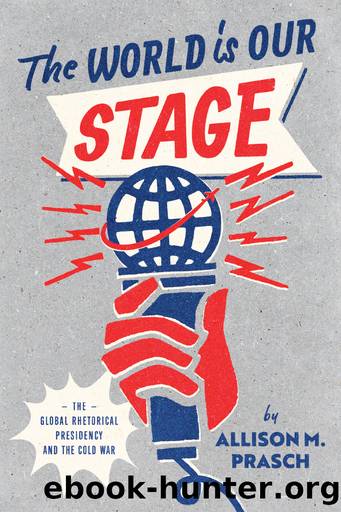
The World Is Our Stage by Allison M. Prasch
Author:Allison M. Prasch [Prasch, Allison M.]
Language: eng
Format: epub
Tags: LAN000000 LANGUAGE ARTS & DISCIPLINES / General, LAN015000 LANGUAGE ARTS & DISCIPLINES / Rhetoric, HIS037070 HISTORY / Modern / 20th Century / General, POL011010 POLITICAL SCIENCE / International Relations / Diplomacy
Publisher: University of Chicago Press
Published: 2023-01-05T00:00:00+00:00
The Reciprocal Banquets
The vivid imagery and political spectacle of Nixonâs arrival extended to the pomp and circumstance of the diplomatic banquets scheduled throughout the week. If the images of Nixon in China displayed the almost unbelievable reality of the president of the United States being welcomed to the PRC by devout communists, the reciprocal toasts between Nixon and Chinese officials gave voice to a new chapter in US-China diplomatic relations. The president delivered five official toasts at five banquets over the course of the week: the February 21 Welcoming Banquet hosted by Chou En-lai at the Great Hall of the People; the February 24 American and Chinese Delegationsâ Private Dinner; the February 25 Reciprocal Banquet hosted by President Nixon at the Great Hall of the People; the February 26 Welcoming Banquet for Nixon hosted by the Provincial Revolutionary Committee of the Province in Hangchow; and the February 27 Banquet for Nixon hosted by the Shanghai Municipal Revolutionary Committee. The White House sought to capitalize on both the visual and verbal elements of these banquets for, as Kissinger explained, these dramatic events were âtelevised live on the morning shows in America [and] performed a deadly serious purpose. They communicated rapidly and dramatically to the peoples of both countries that a new relationship was being forged.â92
A central feature of these banquets was the exchange of toasts between the president and various Chinese officials. The White House prepared numerous possible drafts of these short speeches prior to the trip, but nothing was finalized until the president arrived in China. Nixon played an active role in writing and editing, and the archival record contains dozens of pages of Nixonâs handwritten notes outlining the themes he wished to stress. As Michelle Murray Yang argues, the presidentâs toasts during his week in the PRC showcased his ability to address âmultiple audiences with often conflicting agendasâ and allowed him to âtraverse a rhetorical tightrope, balancing the needs of each audience with the objectives of his mission.â93 The president had to indicate a willingness to partner with his Chinese hosts, reassure conservative US audiences that he was not âselling outâ Taiwan, and convince the American public that this âOpening to Chinaâ marked the beginning of a new, productive friendship. Nevertheless, while Nixonâs rhetorical challenge was to address several audiences, none was more important to his reelection chances than the US public. As with the presidentâs arrival in Peking, the White House scheduled these banquetsâminus the private dinner on February 24âto coincide with American news programming. The dinners and corresponding toasts happened at the same hour as the morning shows, such as the Today Show on NBC. Unlike the ongoing war in Vietnam, the live footage of Nixonâs âOpening to Chinaââand the diplomatic rhetoric that made this opening possibleâsuggested that perhaps this âjourney for peaceâ might succeed.
To US audiences tuning in at home, the February 21 Welcoming Banquet in Peking offered the first real look into the presidentâs public activities in the PRC. After watching Nixonâs arrival on the late Sunday evening news, US audiences awoke Monday morning to live footage of President and Mrs.
Download
This site does not store any files on its server. We only index and link to content provided by other sites. Please contact the content providers to delete copyright contents if any and email us, we'll remove relevant links or contents immediately.
| Arms Control | Diplomacy |
| Security | Trades & Tariffs |
| Treaties | African |
| Asian | Australian & Oceanian |
| Canadian | Caribbean & Latin American |
| European | Middle Eastern |
| Russian & Former Soviet Union |
The Secret History by Donna Tartt(19102)
The Social Justice Warrior Handbook by Lisa De Pasquale(12196)
Thirteen Reasons Why by Jay Asher(8917)
This Is How You Lose Her by Junot Diaz(6892)
Weapons of Math Destruction by Cathy O'Neil(6283)
Zero to One by Peter Thiel(5806)
Beartown by Fredrik Backman(5764)
The Myth of the Strong Leader by Archie Brown(5511)
The Fire Next Time by James Baldwin(5452)
How Democracies Die by Steven Levitsky & Daniel Ziblatt(5223)
Promise Me, Dad by Joe Biden(5156)
Stone's Rules by Roger Stone(5089)
A Higher Loyalty: Truth, Lies, and Leadership by James Comey(4965)
100 Deadly Skills by Clint Emerson(4929)
Rise and Kill First by Ronen Bergman(4796)
Secrecy World by Jake Bernstein(4755)
The David Icke Guide to the Global Conspiracy (and how to end it) by David Icke(4721)
The Farm by Tom Rob Smith(4516)
The Doomsday Machine by Daniel Ellsberg(4492)
